

Hello everyone!
Now that the harvest is over, I’d like to tell you how the year went, as the last twelve months were marked by truly extreme weather events. Last autumn—almost a year ago—saw heavy, steady rainfall, with October and November recording around 150 millimeters. Winter was no different, with precipitation concentrated mainly in January. Inevitably, this delayed our vineyard work, particularly pruning and field grafting for new plantings. You may recall “Cyclone Harry,” a tropical weather system that struck the western Mediterranean—and Sicily in particular—between January 16 and 23 of this year.
Between autumn and spring, rainfall far exceeded seasonal averages, easily surpassing 400 mm. Fortunately, this restored a lush green hue to our countryside during the spring—a sight we hadn’t seen in a long time. Many fruit trees were thriving and heavy with blossoms; it was truly a beautiful awakening. As for vineyard operations, once pruning was finished and the cover crops had been mulched, we were able to apply both Preparation 500 and Preparation 501—which I mentioned in previous newsletters—across all our plots.
The week before Easter, we took preventive action in the vineyards most affected by downy mildew, treating both the soil and the shoots with a horsetail decoction. Field horsetail (*Equisetum arvense*) is an ancient plant whose properties were highlighted by Steiner in his 1924 “Agriculture Course”; a decoction made from it—applied to the soil and shoots in both vineyards and orchards—serves as an excellent preventative measure against fungal diseases like downy mildew. Given the exceptionally wet and rainy spring, in addition to the horsetail decoction, we treated the vineyards with a copper-sulfur mixture to keep mold in check. Furthermore, flowering occurred earlier than in the previous vintage and proceeded without a hitch, yielding healthy grape clusters.
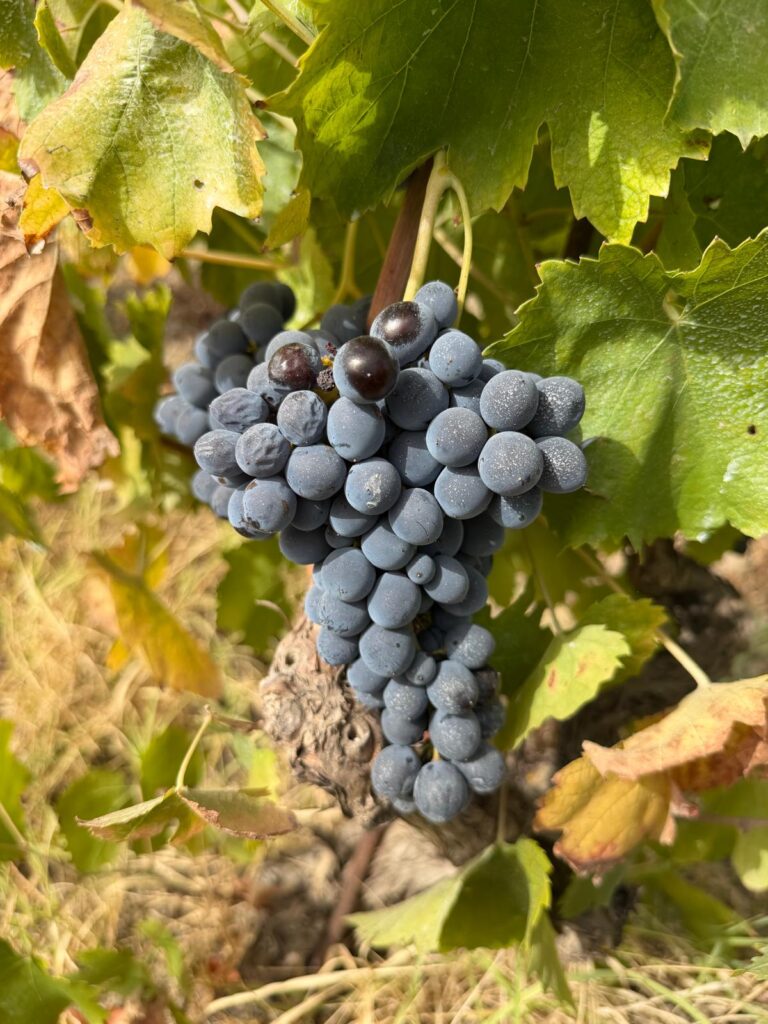
In June, once the shoot-thinning work, as we call it “mazzunatura”, was complete, we applied a chamomile infusion and kaolin—a type of rock dust—to prevent sunburn on the leaves and clusters and to protect the vines from harmful insects. July ushered in a scorching summer, with temperatures soaring above 40°C for several days. By the end of the month, the Moscato grape seeds were already ripe and lignified, and the aromas were rich and intensely fragrant; consequently, we decided to begin the harvest on July 27th with the “Fondo alla Palma” vineyard. We continued harvesting the Moscato vines, finishing on August 4th with an average yield of 46 quintals per hectare. Next, we harvested the Chardonnay grapes between August 5th and 7th. Staying with our white grape varieties, we harvested a new type of grape on August 17th and 18th—though I’ll keep you in suspense about that for now; more on that in due course!
August also proved to be scorching hot, particularly from the second week of the month onwards. On August 24th, we began harvesting the new Nero d’Avola vineyards—Conca Alto, Saia, and Don Paolo. These vines bore few clusters, so we dedicated them to rosé production, alongside our historic plots: Rosa Nera, Signorina, Don Pasquale, and Coniglio. On August 28th, we started harvesting Nero d’Avola for red wines, beginning with a section of the Coniglio vineyard designated for reds, followed by the old Archimede vineyard. On August 29th, we began the harvest in the Parrino vineyard, continuing until September 2nd. We concluded the harvest with the Lenza Lunga vineyard on September 4th.
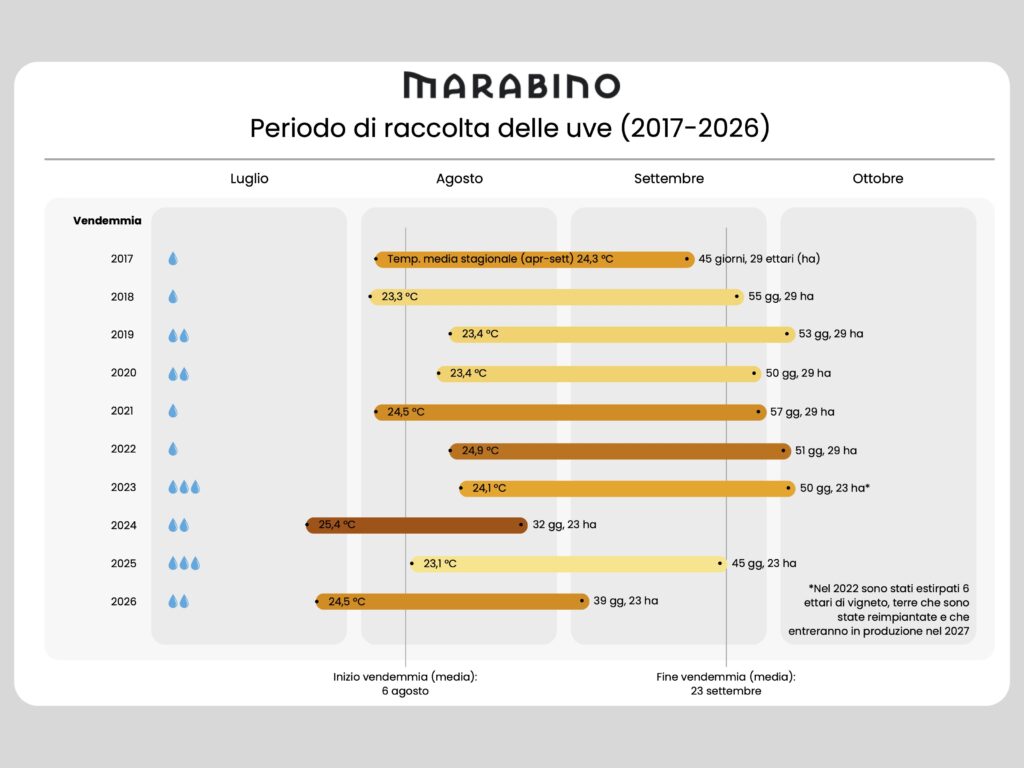
The Nero d’Avola berries were small, loose-clustered, and open—resilient grapes that were partially dehydrated, resulting in a ratio that heavily favored skin over pulp. This reduced juice content led to a good concentration of acids and sugars, along with very uniform ripening. Despite the presence of dehydrated berries, the red wines show absolutely no signs of “cooked” or overripe fruit flavors; instead, they have retained a highly fragrant aroma, accompanied by a full, juicy, and fresh palate. It was a very early harvest, yet it proceeded smoothly, yielding beautiful, healthy grapes with no phytosanitary or pest issues. The infographic below illustrates this well (click to enlarge), comparing our harvests from 2017 to the present: the harvest dates and seasonal temperatures reveal a vintage that ranks among the earliest of the last decade.
I am very satisfied with the resulting wines: despite the extreme conditions, our vines performed exceptionally well, maintaining an excellent balance—the fruit of the work we have been doing on the soils for years. The grapes retained a balanced sugar-to-acidity ratio, and the wines are highly savory, taut, and elegant; they hold great promise.
The 2026 harvest confirms, once again, a key characteristic of this territory: no matter how extreme the climate may be, it consistently yields grapes that are fresh and fully ripe, technologically (with the right sugar levels), phenomically (with mature polyphenols), and physiologically (with perfectly lignified seeds). And all this is achieved without ever losing that typical freshness. It is an almost unexpected freshness, considering we are in a hot, arid region—conditions usually associated with heavy, full-bodied wines lacking freshness. Our wines are the exact opposite, and we couldn’t be happier about it!
Thank you,
Pierpaolo Messina